If you run a printing or packaging unit and you're tired of inconsistent print quality, frequent breakdowns, or machines that simply can't keep up with order volume, you're not alone. Most printers we talk to in Delhi NCR face the same three problems: low output speed, poor color matching, and rising maintenance costs. An Offset Printing Machines solves all three when it's built and chosen correctly.
At Shyam Techno Print, we've spent more than 17 years manufacturing printing and packaging machinery from our facility in Faridabad. We're not a trading company that resells imported machines under a different name — we design, build, and support every Offset Printing Machines Manufacturer that leaves our workshop. This guide walks you through how the machine works, what to look for before you buy, and why businesses across North India choose us as their Offset Printing Machine Manufacturer.
An Offset Printing Machine Manufacturer in Faridabad prints using an indirect method: the image sits on a metal plate, gets transferred to a rubber blanket, and only then touches the paper or material being printed. That extra step — plate to blanket to surface — is exactly why offset printing produces sharper text and more even color than direct-contact printing methods.
This is why offset remains the default choice for anyone printing in bulk: packaging units, publishers, label makers, and non-woven bag manufacturers all rely on it because the cost per print drops sharply as volume goes up, without sacrificing quality.
The process happens in three connected stages. Once you understand these, choosing the right machine becomes a lot easier.
The design is etched onto a metal plate. Ink clings only to the image area; water keeps the rest of the plate clean.
The inked image transfers from the plate onto a rubber blanket. This indirect contact is what gives offset printing its characteristic sharpness and consistency.
Finally, the material being printed — paper, board, or non-woven fabric — passes between the blanket and impression cylinders, where the final image is set down.
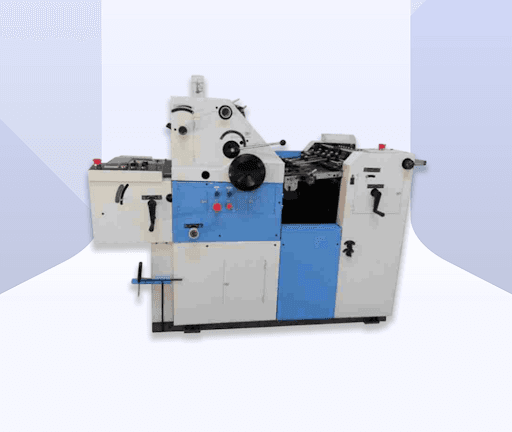
Rather than give you vague marketing claims, here are the actual technical specifications of the 2 Color Offset Printing Machine Manfacturer at our Faridabad facility. These numbers matter when you're comparing machines and planning your production line.
| Specification | Detail |
|---|---|
| Printing Type | Offset |
| Number of Colors | 2 Color (Double) |
| Bag Material | Non-Woven |
| Max Bag Width | 400 mm |
| Max Bag Length | 550 mm |
| Max Bag Size | 16 x 22 inch |
| Min Bag Size | 5 x 7 inch |
| Max Printing Area | 15.5 x 21 inch |
| Plate Size | 17.5 x 22 inch |
| Blanket Size | 19.5 x 22 inch |
| Max Speed | 40–50 bags/min (approx. 2000 IPH) |
| Ink Roller System | 13 + 10 ink rollers |
| Water Roller System | 5 + 3 water rollers |
| Gripper Margin | 8 mm |
| Bag Thickness | 35 GSM |
| Power Required | 2 kW / 240V, 50Hz |
| Machine Weight | 1700 Kg |
| Dimensions | 1800 x 1400 x 1400 mm |
| Brand | Shyam Techno Print |
| Country of Origin | Made in India |
These specifications make this machine particularly well-suited to non-woven bag printing, packaging units, and businesses producing mid-size bags and pouches at industrial scale. If your production needs differ — larger sheet sizes, more colors, or paper-based stock instead of non-woven — we can guide you to the right configuration based on your actual order volumes.
Prints on individual sheets and suits brochures, books, magazines, and general commercial print jobs where flexibility in stock size matters.
Runs off continuous paper rolls instead of sheets, making it the right choice for newspapers, catalogs, and any job where volume is high and turnaround time is tight.
Built for simpler jobs where one ink color covers the requirement — often the most economical entry point for a smaller operation.
Prints two or more colors in a single pass. Our 2 Color model, detailed above, falls in this category and is built specifically for non-woven bag and packaging applications.
Offset Printing Machines serve a wide range of industries because the underlying process works on so many materials and formats:
Before you commit to a machine, work through these five questions honestly. Skipping any one of them is how businesses end up with equipment that doesn't match their actual needs.
Don't buy for the volume you hope to hit someday — buy for where your orders actually sit today, with some headroom for growth. A machine rated for 40–50 bags per minute is wasted capacity if your current orders need a fraction of that, and undersized if you're already turning down work.
Single color machines cost less to run and maintain. Multi-color machines open up premium-looking work but add complexity. Match the machine to your typical job, not your most ambitious one.
Non-woven, paper, board, and coated sheets all behave differently on press. Confirm the machine's plate size, blanket size, and printing area cover your actual product range — not just your current best-seller.
This determines whether a single or multi-color setup pays for itself faster, and how soon you'll need to think about a second machine or shift work.
Purchase price is only part of the picture. Power consumption, spare parts availability, and how easily you can get a technician on-site all affect what the machine actually costs you over five years.
This is the comparison every buyer eventually asks about. Here's how the two stack up:
| Factor | Offset Printing | Digital Printing |
|---|---|---|
| Print Quality | Excellent, especially at scale | Good for short runs |
| Bulk Printing Cost | Lower per unit at volume | Higher per unit at volume |
| Color Consistency | Excellent across long runs | Good but can drift |
| Setup Time | Higher (plates, registration) | Lower, near-instant |
| Best For | Medium to large production runs | Short runs, quick turnarounds |
If your business runs consistent bulk orders — packaging, non-woven bags, or commercial print runs in the thousands — offset printing's lower per-unit cost and superior consistency make it the stronger long-term investment. Digital printing still has its place for short-run, fast-turnaround jobs where setup time matters more than unit cost.
We're based in the Sarurpur Industrial Area of Faridabad, and our address is registered and verifiable: Plot No. E-26, Gali No. 5E, Industrial Area, Sarurpur, Ballabgarh, Faridabad-121004 (Haryana). We're not a marketing front for someone else's factory — we manufacture on-site.
Close to two decades of manufacturing experience means we've already solved most of the problems a new buyer is worried about — from registration accuracy to long-term roller wear.
Beyond Offset Printing Machines Manufacture in faridabad, Square Bottom and V Bottom Paper Bag Making Machines, Non-Woven Bag Making Machines, Flexo Printing Machines, Medical Pouch Making Machines, and related packaging equipment. If your business needs more than one machine in its production line, we can supply a matched set rather than mixing brands.
Every machine we quote comes with documented specifications — speed, power draw, dimensions, weight — the same kind of real numbers shown in the table earlier in this guide, not vague claims of “advanced technology.”
Installation, operator training, spare parts, and technical support are handled directly by our team, not outsourced to a third party.
While we're proud to serve as an Offset Printing Machine Manufacturer in Faridabad, our machines are supplied across Delhi NCR, Haryana, Punjab, Rajasthan, Uttar Pradesh, Gujarat, Maharashtra, and West Bengal.
Offset printing machine manufacturer isn't standing still. Buyers evaluating a purchase in 2026 should know what's becoming standard:
We factor these developments into how we design and upgrade our machines, so the equipment you buy today doesn't fall behind industry standards within a year or two.
Shyam Techno Print, located in the Sarurpur Industrial Area of Faridabad, has manufactured printing and packaging machinery for more than 17 years and provides documented specifications and after-sales support for every Offset Printing Machine it sells.
It's used for printing books, packaging, non-woven bags, labels, brochures, newspapers, and a wide range of commercial print products where consistent quality at volume matters.
Our 2 Color Offset Printing Machine runs at approximately 40–50 bags per minute (around 2000 IPH), suited to industrial non-woven bag and packaging production.
For medium to large production volumes, yes — offset printing offers a lower cost per unit and tighter color consistency across long runs. Digital printing remains better suited to short runs and quick one-off jobs.
Yes. Our team handles installation, operator training, and ongoing technical support directly, along with spare parts availability.
From our Faridabad facility, we supply Offset Printing Machines and related packaging equipment across Delhi NCR, Haryana, Punjab, Rajasthan, Uttar Pradesh, Gujarat, Maharashtra, and West Bengal.
Plot No. E-26, Gali No. 5E, Industrial Area, Sarurpur, Ballabgarh, Faridabad-121004, Haryana.
Common types include Sheet Fed Offset Printing Machines, Web Offset Printing Machines, Single Color Offset Printing Machines, and Multi Color Offset Printing Machines, each suited to different production needs.
The price depends on machine size, number of colors, printing speed, and automation level, so it's best to get a customised quote based on your production requirements.
Offset Printing Machines can print on paper, non-woven fabric, board, and coated sheets, making them suitable for packaging, books, labels, and commercial printing.